
How AI Coding Assistants Are Changing Software Development
Why developers are building faster, smarter, and more creatively than ever before
Artificial Intelligence is no longer a futuristic idea in the world of programming—it’s now an everyday tool. From writing code to debugging entire applications, AI coding assistants have transformed how software is built. Tools like ChatGPT, GitHub Copilot, Codeium, Tabnine, Amazon CodeWhisperer, and Google’s Gemini have ushered in a new era of efficiency and innovation.
Rather than replacing developers, these tools are augmenting human abilities, allowing programmers to focus on logic, architecture, and creativity instead of repetitive tasks. This shift is reshaping teams, workflows, and the very definition of what it means to be a developer.
What Exactly Are AI Coding Assistants?
AI coding assistants are AI-powered tools that help developers write, analyze, and improve code. They use machine learning models trained on massive code datasets to understand patterns and provide intelligent suggestions.
Capabilities include:
- Autocomplete of entire functions, not just single lines
- Documentation generation
- Bug detection and error fixing
- Code refactoring for readability and performance
- Test case generation
- Explaining complex code
- Supporting multiple programming languages
- Generating boilerplate, configuration files, and project structure
This makes them far more advanced than traditional IDE hints or autocomplete.
1. AI Is Helping Developers Code Faster
One of the biggest impacts of AI coding assistants is speed. Developers can now produce code in minutes that once took hours.
How AI speeds up coding:
- Predicting what a developer wants to write before they type it
- Auto-generating repetitive code (API calls, loops, CRUD operations)
- Creating templates for entire components or classes
- Completing functions based on comments
- Suggesting optimized versions of existing code
For example, a developer working with React can describe the UI component they need, and the assistant can generate the entire boilerplate.
The result?
Projects that used to take months can now be built in weeks. MVPs and prototypes are created faster, reducing market risk for startups.
2. AI Makes Debugging and Problem-Solving More Efficient
Bug hunting is often the most time-consuming part of development. AI coding assistants can analyze errors quickly and suggest fixes.
AI helps by:
- Identifying the root cause of bugs
- Explaining cryptic error messages
- Suggesting corrected code
- Running through logic to find vulnerabilities
- Spotting misconfigurations in frameworks
Developers spend less time searching StackOverflow and more time implementing solutions.
3. AI Improves Code Quality and Consistency
AI tools can enforce best practices and maintain consistent coding style across large teams.
AI improves code quality by:
- Suggesting cleaner, more readable code
- Flagging security vulnerabilities
- Detecting inefficient algorithms
- Highlighting unused imports or variables
- Suggesting modern design patterns
This is especially powerful for teams working on massive codebases where consistency is critical.
4. AI Is Democratizing Software Development
Perhaps the most profound change is how AI lowers the entry barrier for beginners.
With AI coding assistants:
- New developers get instant explanations of code
- Learners can ask for step-by-step guides
- Beginners can build real applications without advanced knowledge
- Non-technical founders can create MVPs
- Students can learn multiple languages faster
AI doesn’t replace learning—it accelerates it.
This democratization encourages innovation, making software development accessible to more people worldwide.
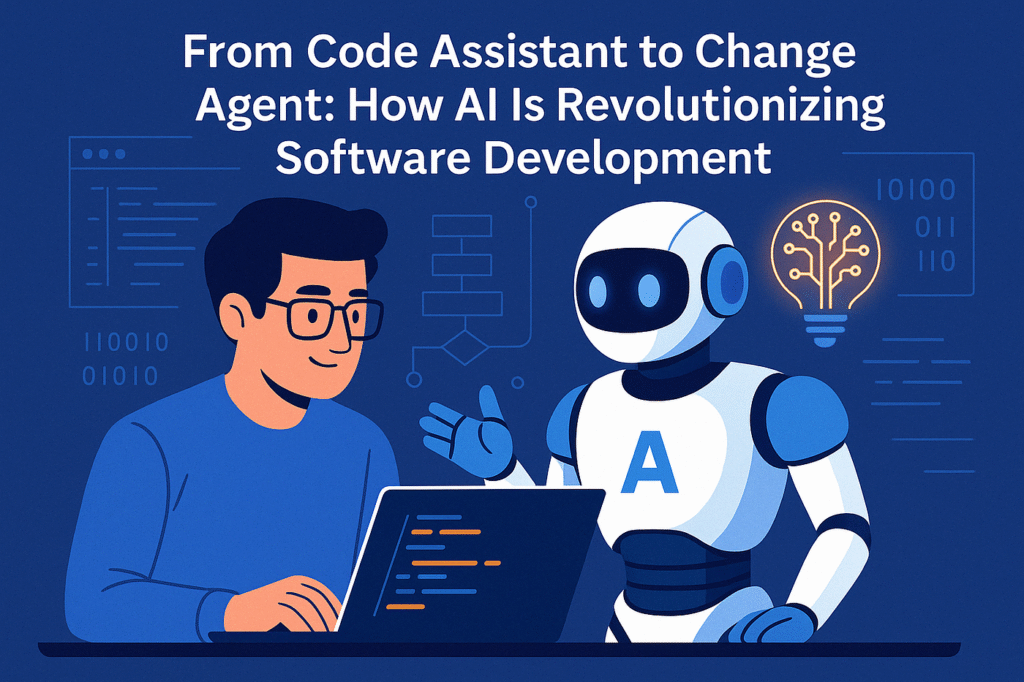
5. AI Enhances Collaboration in Development Teams
AI coding assistants also serve as a “virtual pair programmer.” Instead of two humans pairing, developers now pair with AI.
AI boosts collaboration by:
- Providing shared coding suggestions across the team
- Standardizing documentation
- Helping teams adhere to the same coding style
- Supporting cross-language development
- Speeding up code review processes
Even junior developers can contribute high-quality code with the help of AI.
6. AI Assistants Are Reshaping the Role of Developers
The role of a developer is shifting from manual coding to higher-level thinking.
Developers now focus more on:
- System architecture
- Problem-solving
- Creativity and product vision
- Understanding user needs
- Integrating diverse technologies
- Validating AI-generated outputs
In this new landscape, developers become strategists, not just coders.
7. AI Enables Rapid Prototyping and Innovation
Startups and companies can build prototypes at lightning speed using AI coding tools.
AI helps innovation by:
- Generating sample code for new ideas
- Letting teams test multiple approaches quickly
- Reducing development costs
- Enabling A/B testing faster
- Supporting new frameworks instantly
This dramatically reduces the time from idea → product.
8. AI Coding Tools Are Expanding Into Testing and DevOps
Beyond writing code, AI is now moving deeper into the development lifecycle.
AI in Testing
- Creates unit tests automatically
- Generates edge cases
- Detects flaky tests
- Suggests missing test coverage
AI in DevOps
- Generates CI/CD pipelines
- Optimizes cloud configuration
- Automates deployment scripts
- Monitors systems for anomalies
Soon, entire application environments may be AI-managed.
9. What AI Can’t Replace
Despite the hype, AI is not replacing developers. Instead, it enhances them.
AI cannot replace:
- Creativity and product vision
- Critical thinking
- Understanding business logic
- Complex architecture design
- Ethical decision-making
- Human collaboration and communication
Developers who learn to work with AI—not against it—will thrive.
10. The Future of AI in Software Development
Over the next decade, AI tools will become even more integrated into development workflows.
Expect the future to bring:
- Self-improving codebases
- Autonomous debugging
- AI-generated microservices
- Intelligent cloud scaling
- On-demand project scaffolds
- Smarter security detection
- AI-driven code reviews
- Fully conversational coding environments
Software development will become more about guiding AI, not typing code line by line.
Final Thoughts
AI coding assistants are not just a convenience—they’re a revolution. They’re elevating productivity, improving code quality, and enabling more people to become software creators. Developers who embrace these tools gain superpowers. They work faster, think bigger, and build more impactful solutions.
The future of coding is not AI vs. humans.
It’s AI + humans, building the future together.